The Trifid Nebula (catalogued as Messier 20 or M20 and as NGC 6514) is an H II region located in Sagittarius. Its name means 'divided into three lobes'. The object is an unusual combination of an open cluster of stars; an emission nebula (the lower, red portion), a reflection nebula (the upper, blue portion) and a dark nebula (the apparent 'gaps' within the emission nebula that cause the trifid appearance; these are also designated Barnard 85). Viewed through a small telescope, the Trifid Nebula is a bright and peculiar object, and is thus a perennial favorite of amateur astronomers.
Extraterrestrial
Tuesday, 5 March 2013
Trifid
The Trifid Nebula (catalogued as Messier 20 or M20 and as NGC 6514) is an H II region located in Sagittarius. Its name means 'divided into three lobes'. The object is an unusual combination of an open cluster of stars; an emission nebula (the lower, red portion), a reflection nebula (the upper, blue portion) and a dark nebula (the apparent 'gaps' within the emission nebula that cause the trifid appearance; these are also designated Barnard 85). Viewed through a small telescope, the Trifid Nebula is a bright and peculiar object, and is thus a perennial favorite of amateur astronomers.
Horsehead
The Horsehead Nebula (also known as Barnard 33 in emission nebula IC 434) is a dark nebula in the constellation Orion. The nebula is located just to the south of the star Alnitak, which is farthest east on Orion's Belt, and is part of the much larger Orion Molecular Cloud Complex. The nebula was first recorded in 1888 by Williamina Fleming on photographic plate B2312 taken at the Harvard College Observatory. The Horsehead Nebula is approximately 1500 light years from Earth. It is one of the most identifiable nebulae because of the shape of its swirling cloud of dark dust and gases, which is similar to that of a horse's head when viewed from Earth.
The red or pinkish glow originates from hydrogen gas predominantly behind the nebula, ionized by the nearby bright star Sigma Orionis. The darkness of the Horsehead is caused mostly by thick dust, although the lower part of the Horsehead's neck casts a shadow to the left. Streams of gas leaving the nebula are funneled by a strong magnetic field. Bright spots in the Horsehead Nebula's base are young stars just in the process of forming.
The nebula exhibits a noticeable change in the density of the stars which indicates that a red ribbon of radiant red hydrogen gas at the precipice of a sizable dark cloud. The underside of the horse’s visible ‘neck’ reflects this concept of shade and density because it casts a great shadow across the field of view just below the horse’s ‘muzzle’. The visible heart of the nebula emerges from the gaseous complex to serve as an active site of the formation of “low-mass” stars. A glowing strip of hydrogen gas marks the edge of the massive cloud and noticeable densities of stars are present on either side.
Eagle
The Eagle Nebula (catalogued as Messier 16 or M16, and as NGC 6611, and also known as the Star Queen Nebula) is a young open cluster of stars in the constellation Serpens, discovered by Jean-Philippe de Cheseaux in 1745-46. Its name derives from its shape that is thought to resemble an eagle. It is the subject of the famous "Pillars of Creation" photograph by the Hubble Space Telescope that shows pillars of star-forming gas and dust within the nebula.
Cat's Eye
The Cat's Eye Nebula (NGC 6543, Caldwell 6) is a planetary nebula in the constellation of Draco. Structurally, it is one of the most complex nebulae known, with high-resolution Hubble Space Telescope observations revealing remarkable structures such as knots, jets, bubbles and sinewy arc-like features. In the center of the Cat's Eye there is a bright and hot star; around 1000 years ago this star lost its outer envelope, producing the nebula.
It was discovered by William Herschel on February 15, 1786, and was the first planetary nebula whose spectrum was investigated by the English amateur astronomer William Huggins in 1864. The results of the latter investigation demonstrated for the first time that planetary nebulae consist of hot gases, but not stars. Currently the nebula has been observed across the full electromagnetic spectrum, from far-infrared to X-rays.
Modern studies reveal several mysteries. The intricacy of the structure may be caused in part by material ejected from a binary central star, but as yet, there is no direct evidence that the central star has a companion. Also, measurements of chemical abundances reveal a large discrepancy between measurements done by two different methods, the cause of which is uncertain. Hubble Telescope observations revealed a number of faint rings around the Eye, which are spherical shells ejected by the central star in the distant past. The exact mechanism of those ejections, however, is unclear.
Andromeda
The Andromeda Galaxy is a spiral galaxy approximately 2.5 million light-years (2.4×10¹⁹ km) from Earthin the Andromeda constellation. Also known as Messier 31, M31, or NGC 224, it is often referred to as the Great Andromeda Nebula in older texts. The Andromeda Galaxy is the nearest spiral galaxy to our Milky Way galaxy, but not the closest galaxy overall. It gets its name from the area of the sky in which it appears, the constellation of Andromeda, which was named after the mythological princess Andromeda. The Andromeda Galaxy is the largest galaxy of the Local Group, which also contains the Milky Way, the Triangulum Galaxy, and about 30 other smaller galaxies. Although the largest, the Andromeda Galaxy may not be the most massive, as recent findings suggest that the Milky Way contains more dark matter and could be the most massive in the grouping. The 2006 observations by the Spitzer Space Telescope revealed that M31 contains one trillion (1012) stars: at least twice the number of stars in the Milky Way galaxy, which is estimated to be 200–400 billion.
The Andromeda Galaxy is estimated to be 7.1×10¹¹ solar masses. In comparison a 2009 study estimated that the Milky Way and M31 are about equal in mass,while a 2006 study put the mass of the Milky Way at ~80% of the mass of the Andromeda Galaxy. The two galaxies are expected to collide in 3.75 billion years, eventually merging to form a giant elliptical galaxy.
At an apparent magnitude of 3.4, the Andromeda Galaxy is notable for being one of the brightest Messier objects, making it visible to the naked eye on moonless nights even when viewed from areas with moderate light pollution. Although it appears more than six times as wide as the full Moon when photographed through a larger telescope, only the brighter central region is visible to the naked eye or when viewed using binoculars or a small telescope.
Small Magellanic Cloud
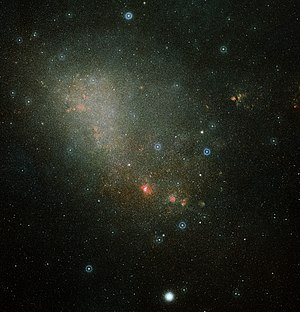
Some speculate that the SMC was once a barred spiral galaxy that was disrupted by the Milky Way to become somewhat irregular. It contains a central bar structure.
At a distance of about 200,000 light-years, it is one of the Milky Way's nearest neighbors. It is also one of the most distant objects that can be seen with the naked eye.
With a mean declination of approximately −73 degrees, it can only be viewed from the Southern Hemisphere and the lower latitudes of the Northern Hemisphere. It is located in the constellation of Tucana and appears as a hazy, light patch in the night sky about 3 degrees across. It looks like a detached piece of the Milky Way. Since it has a very low surface brightness, it is best viewed from a dark site away from city lights.
It forms a pair with the Large Magellanic Cloud (LMC), which lies a further 20 degrees to the east. The Small Magellanic Cloud is a member of the Local Group.
Large Magellanic Cloud
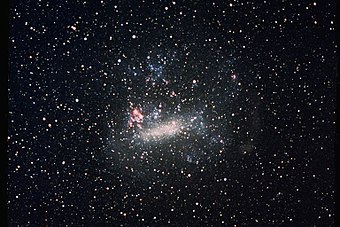
While the LMC is often considered an irregular type galaxy (the NASA Extragalactic Database lists the Hubble sequence type as Irr/SB(s)m), the LMC contains a very prominent bar in its center, suggesting that it may have previously been a barred spiral galaxy. The LMC's irregular appearance is possibly the result of tidal interactions with both the Milky Way, as well as the Small Magellanic Cloud (SMC).
It is visible as a faint "cloud" in the night sky of the southern hemisphere straddling the border between the constellations of Dorado and Mensa.
The Seashore of the Large Magellanic Cloud
Subscribe to:
Comments (Atom)