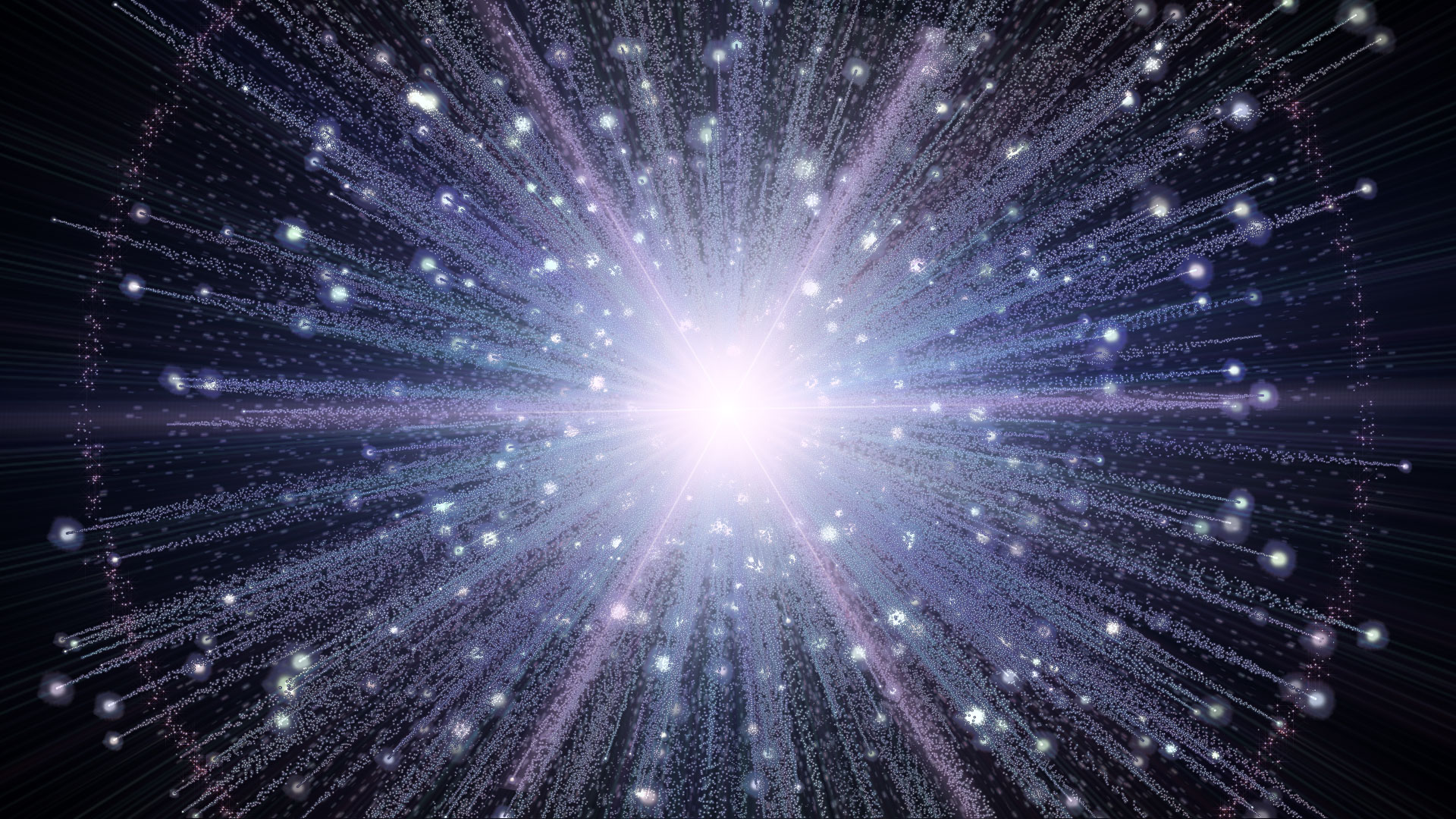
 The Big Bang theory is the
prevailing cosmological model that describes the early development of the
Universe. According to the theory, the Big Bang occurred approximately 13.77
billion years ago, which is thus considered the age of the universe. After this
time, the Universe was in an extremely hot and dense state and began expanding
rapidly. After the initial expansion, the Universe cooled sufficiently to allow
energy to be converted into various subatomic particles, including protons,
neutrons, and electrons. Though simple atomic nuclei could have formed quickly,
thousands of years were needed before the appearance of the first electrically
neutral atoms. The first element produced was hydrogen, along with traces of
helium and lithium. Giant clouds of these primordial elements later coalesced
through gravity to form stars and galaxies, and the heavier elements were
synthesized either within stars or during supernovae.
The Big Bang theory is the
prevailing cosmological model that describes the early development of the
Universe. According to the theory, the Big Bang occurred approximately 13.77
billion years ago, which is thus considered the age of the universe. After this
time, the Universe was in an extremely hot and dense state and began expanding
rapidly. After the initial expansion, the Universe cooled sufficiently to allow
energy to be converted into various subatomic particles, including protons,
neutrons, and electrons. Though simple atomic nuclei could have formed quickly,
thousands of years were needed before the appearance of the first electrically
neutral atoms. The first element produced was hydrogen, along with traces of
helium and lithium. Giant clouds of these primordial elements later coalesced
through gravity to form stars and galaxies, and the heavier elements were
synthesized either within stars or during supernovae.
The Big Bang is a well-tested
scientific theory and is widely accepted within the scientific community. It
offers a comprehensive explanation for a broad range of observed phenomena,
including the abundance of light elements, the cosmic microwave background,
large scale structure, and the Hubble diagram for Type Ia supernovae.The core
ideas of the Big Bang—the expansion, the early hot state, the formation of
helium, and the formation of galaxies—are derived from these and other
observations that are independent of any cosmological model. As the distance
between galaxy clusters is increasing today, it is inferred that everything was
closer together in the past. This idea has been considered in detail back in
time to extreme densities and temperatures, and large particle accelerators
have been built to experiment in such conditions, resulting in further
development of the model. On the other hand, these accelerators have limited
capabilities to probe into such high energy regimes. There is little evidence
regarding the absolute earliest instant of the expansion. Thus, the Big Bang
theory cannot and does not provide any explanation for such an initial
condition; rather, it describes and explains the general evolution of the
universe going forward from that point on.

No comments:
Post a Comment