Tuesday, 5 March 2013

Trifid


The Trifid Nebula (catalogued as Messier 20 or M20 and as NGC 6514) is an H II region located in Sagittarius. Its name means 'divided into three lobes'. The object is an unusual combination of an open cluster of stars; an emission nebula (the lower, red portion), a reflection nebula (the upper, blue portion) and a dark nebula (the apparent 'gaps' within the emission nebula that cause the trifid appearance; these are also designated Barnard 85). Viewed through a small telescope, the Trifid Nebula is a bright and peculiar object, and is thus a perennial favorite of amateur astronomers.

Horsehead


The Horsehead Nebula (also known as Barnard 33 in emission nebula IC 434) is a dark nebula in the constellation Orion. The nebula is located just to the south of the star Alnitak, which is farthest east on Orion's Belt, and is part of the much larger Orion Molecular Cloud Complex. The nebula was first recorded in 1888 by Williamina Fleming on photographic plate B2312 taken at the Harvard College Observatory. The Horsehead Nebula is approximately 1500 light years from Earth. It is one of the most identifiable nebulae because of the shape of its swirling cloud of dark dust and gases, which is similar to that of a horse's head when viewed from Earth.

The red or pinkish glow originates from hydrogen gas predominantly behind the nebula, ionized by the nearby bright star Sigma Orionis. The darkness of the Horsehead is caused mostly by thick dust, although the lower part of the Horsehead's neck casts a shadow to the left. Streams of gas leaving the nebula are funneled by a strong magnetic field. Bright spots in the Horsehead Nebula's base are young stars just in the process of forming.

The nebula exhibits a noticeable change in the density of the stars which indicates that a red ribbon of radiant red hydrogen gas at the precipice of a sizable dark cloud. The underside of the horse’s visible ‘neck’ reflects this concept of shade and density because it casts a great shadow across the field of view just below the horse’s ‘muzzle’. The visible heart of the nebula emerges from the gaseous complex to serve as an active site of the formation of “low-mass” stars. A glowing strip of hydrogen gas marks the edge of the massive cloud and noticeable densities of stars are present on either side.

The dark cloud of dust and gas is a region in the Orion Nebula where star formation is taking place right now. A complex housing forming stars, known as a stellar nursery, can contain over 100 known organic and inorganic gases as well of dust consisting of large and complex organic molecules. The region of the Orion Nebula containing the Horsehead is a stellar nursery. The darkness of the massive nebula is not explained by this dust and gas, but by the complex blocking the light of stars behind it. The heavy concentrations of dust in the Horsehead Nebula region and neighbouring Orion Nebula are localized, resulting in alternating sections of nearly complete opacity and transparency

Eagle


The Eagle Nebula (catalogued as Messier 16 or M16, and as NGC 6611, and also known as the Star Queen Nebula) is a young open cluster of stars in the constellation Serpens, discovered by Jean-Philippe de Cheseaux in 1745-46. Its name derives from its shape that is thought to resemble an eagle. It is the subject of the famous "Pillars of Creation" photograph by the Hubble Space Telescope that shows pillars of star-forming gas and dust within the nebula.

Cat's Eye


The Cat's Eye Nebula (NGC 6543, Caldwell 6) is a planetary nebula in the constellation of Draco. Structurally, it is one of the most complex nebulae known, with high-resolution Hubble Space Telescope observations revealing remarkable structures such as knots, jets, bubbles and sinewy arc-like features. In the center of the Cat's Eye there is a bright and hot star; around 1000 years ago this star lost its outer envelope, producing the nebula.

It was discovered by William Herschel on February 15, 1786, and was the first planetary nebula whose spectrum was investigated by the English amateur astronomer William Huggins in 1864. The results of the latter investigation demonstrated for the first time that planetary nebulae consist of hot gases, but not stars. Currently the nebula has been observed across the full electromagnetic spectrum, from far-infrared to X-rays.

Modern studies reveal several mysteries. The intricacy of the structure may be caused in part by material ejected from a binary central star, but as yet, there is no direct evidence that the central star has a companion. Also, measurements of chemical abundances reveal a large discrepancy between measurements done by two different methods, the cause of which is uncertain. Hubble Telescope observations revealed a number of faint rings around the Eye, which are spherical shells ejected by the central star in the distant past. The exact mechanism of those ejections, however, is unclear.

Andromeda


The Andromeda Galaxy is a spiral galaxy approximately 2.5 million light-years (2.4×10¹⁹ km) from Earthin the Andromeda constellation. Also known as Messier 31, M31, or NGC 224, it is often referred to as the Great Andromeda Nebula in older texts. The Andromeda Galaxy is the nearest spiral galaxy to our Milky Way galaxy, but not the closest galaxy overall. It gets its name from the area of the sky in which it appears, the constellation of Andromeda, which was named after the mythological princess Andromeda. The Andromeda Galaxy is the largest galaxy of the Local Group, which also contains the Milky Way, the Triangulum Galaxy, and about 30 other smaller galaxies. Although the largest, the Andromeda Galaxy may not be the most massive, as recent findings suggest that the Milky Way contains more dark matter and could be the most massive in the grouping. The 2006 observations by the Spitzer Space Telescope revealed that M31 contains one trillion (1012) stars: at least twice the number of stars in the Milky Way galaxy, which is estimated to be 200–400 billion.

The Andromeda Galaxy is estimated to be 7.1×10¹¹ solar masses. In comparison a 2009 study estimated that the Milky Way and M31 are about equal in mass,while a 2006 study put the mass of the Milky Way at ~80% of the mass of the Andromeda Galaxy. The two galaxies are expected to collide in 3.75 billion years, eventually merging to form a giant elliptical galaxy.

At an apparent magnitude of 3.4, the Andromeda Galaxy is notable for being one of the brightest Messier objects, making it visible to the naked eye on moonless nights even when viewed from areas with moderate light pollution. Although it appears more than six times as wide as the full Moon when photographed through a larger telescope, only the brighter central region is visible to the naked eye or when viewed using binoculars or a small telescope.

Small Magellanic Cloud

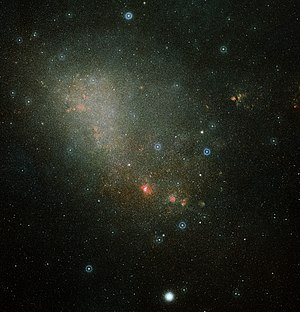
Small Magellanic Cloud (Digitized Sky Survey 2).jpgThe Small Magellanic Cloud (SMC) is a dwarf galaxy. It has a diameter of about 7,000 light-years and contains several hundred million stars. It has a total mass of approximately 7 billion times the mass of the Sun.

Some speculate that the SMC was once a barred spiral galaxy that was disrupted by the Milky Way to become somewhat irregular. It contains a central bar structure.
At a distance of about 200,000 light-years, it is one of the Milky Way's nearest neighbors. It is also one of the most distant objects that can be seen with the naked eye.

With a mean declination of approximately −73 degrees, it can only be viewed from the Southern Hemisphere and the lower latitudes of the Northern Hemisphere. It is located in the constellation of Tucana and appears as a hazy, light patch in the night sky about 3 degrees across. It looks like a detached piece of the Milky Way. Since it has a very low surface brightness, it is best viewed from a dark site away from city lights.
It forms a pair with the Large Magellanic Cloud (LMC), which lies a further 20 degrees to the east. The Small Magellanic Cloud is a member of the Local Group.

Large Magellanic Cloud

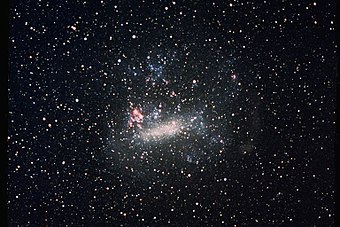
Large.mc.arp.750pix.jpgThe Large Magellanic Cloud (LMC) is a nearby irregular galaxy, and a satellite of the Milky Way. At a distance of slightly less than 50 kiloparsecs (≈160,000 light-years), the LMC is the third closest galaxy to the Milky Way, with the Sagittarius Dwarf Spheroidal (~ 16 kiloparsecs) and Canis Major Dwarf Galaxy (~ 12.9 kiloparsecs) lying closer to the center of the Milky Way. It has a mass equivalent to approximately 10 billion times the mass of our Sun (1010 solar masses), making it roughly 1/100 as massive as the Milky Way, and a diameter of about 14,000 light-years (~ 4.3 kpc). The LMC is the fourth largest galaxy in the Local Group, after the Andromeda Galaxy (M31), our own Milky Way Galaxy, and the Triangulum Galaxy (M33).

While the LMC is often considered an irregular type galaxy (the NASA Extragalactic Database lists the Hubble sequence type as Irr/SB(s)m), the LMC contains a very prominent bar in its center, suggesting that it may have previously been a barred spiral galaxy. The LMC's irregular appearance is possibly the result of tidal interactions with both the Milky Way, as well as the Small Magellanic Cloud (SMC).
It is visible as a faint "cloud" in the night sky of the southern hemisphere straddling the border between the constellations of Dorado and Mensa.

See Explanation.  Clicking on the picture will download
 the highest resolution version available.
The Seashore of the Large Magellanic Cloud

Milky Way


The Greek philosopher Democritus (450–370 BC) proposed that the bright band on the night sky known as the Milky Way might consist of distant stars.Aristotle (384–322 BC), however, believed the Milky Way to be caused by "the ignition of the fiery exhalation of some stars that were large, numerous and close together" and that the "ignition takes place in the upper part of the atmosphere, in the region of the World that is continuous with the heavenly motions." The Neoplatonist philosopher Olympiodorus the Younger (c. 495–570 AD) was scientifically critical of this view, arguing that if the Milky Way were sublunary it should appear different at different times and places on the Earth, and that it should have parallax, which it does not. In his view, the Milky Way was celestial. This idea would be influential later in the Islamic world.

According to Mohani Mohamed, the Arabian astronomer Alhazen (965–1037) made the first attempt at observing and measuring the Milky Way's parallax, and he thus "determined that because the Milky Way had no parallax, it was very remote from the Earth and did not belong to the atmosphere." The Persian astronomer al-BÄ«rÅ«nÄ« (973–1048) proposed the Milky Way galaxy to be "a collection of countless fragments of the nature of nebulous stars." The Andalusian astronomer Ibn Bajjah ("Avempace", d. 1138) proposed that the Milky Way was made up of many stars that almost touch one another and appear to be a continuous image due to the effect of refraction from sublunary material, citing his observation of the conjunction of Jupiter and Mars as evidence of this occurring when two objects are near. In the 14th century, the Syrian-born Ibn Qayyim proposed the Milky Way galaxy to be "a myriad of tiny stars packed together in the sphere of the fixed stars".

Actual proof of the Milky Way consisting of many stars came in 1610 when the Italian astronomer Galileo Galilei used a telescope to study the Milky Way and discovered that it is composed of a huge number of faint stars. In 1750 the English astronomer Thomas Wright, in his An original theory or new hypothesis of the Universe, speculated (correctly) that the galaxy might be a rotating body of a huge number of stars held together by gravitational forces, akin to the solar system but on a much larger scale. The resulting disk of stars can be seen as a band on the sky from our perspective inside the disk. In a treatise in 1755, Immanuel Kant elaborated on Wright's idea about the structure of the Milky Way.

The shape of the Milky Way as deduced from star counts by William Herschel in 1785; the solar system was assumed to be near the center.

The first attempt to describe the shape of the Milky Way and the position of the Sun in it was carried out by William Herschel in 1785 by carefully counting the number of stars in different regions of the sky. He produced a diagram of the shape of the galaxy with the solar system close to the center.Using a refined approach, Kapteyn in 1920 arrived at the picture of a small (diameter about 15 kiloparsecs) ellipsoid galaxy with the Sun close to the center. A different method by Harlow Shapley based on the cataloguing of globular clusters led to a radically different picture: a flat disk with diameter approximately 70 kiloparsecs and the Sun far from the center. Both analyses failed to take into account the absorption of light by interstellar dust present in the galactic plane, but after Robert Julius Trumpler quantified this effect in 1930 by studying open clusters, the present picture of our host galaxy, the Milky Way, emerged.

Betelgeuse


Red supergiant star Betelgeuse

Betelgeuse, also known by its Bayer designation Alpha Orionis (α Orionis, α Ori), is the eighth-brightest star in the night sky and second-brightest in the constellation of Orion. Distinctly reddish, it is a semiregular variable star whose apparent magnitude varies between 0.2 and 1.2, the widest range of any first-magnitude star. Betelgeuse is one of three stars that make up the Winter Triangle, and it marks the center of the Winter Hexagon. The star's name is derived from the Arabic يد Ų§Ł„Ų¬ŁˆŲ²Ų§Ų” Yad al-Jauzā', meaning "the Hand of al-Jauzā'", i.e. Orion, with mistransliteration into medieval Latin leading to the first character y being misread as a b.

The star is classified as a red supergiant of spectral type M2Iab and is one of the largest and most luminous observable stars. If Betelgeuse were at the center of the Solar System, its surface would extend past the asteroid belt, possibly to the orbit of Jupiter and beyond, wholly engulfing Mercury, Venus, Earth and Mars. Estimates of its mass are poorly constrained, but range from 5 to 30 times that of the Sun. Its distance from Earth was estimated in 2008 at 640 light-years, yielding a mean absolute magnitude of about −6.02. Less than 10 million years old, Betelgeuse has evolved rapidly because of its high mass. Having been ejected from its birthplace in the Orion OB1 Association—which includes the stars in Orion's Belt—this crimson runaway has been observed moving through the interstellar medium at a supersonic speed of 30 km/sec, creating a bow shock over 4 light-years wide. Currently in a late stage of stellar evolution, the supergiant is expected to proceed through its life cycle before exploding as a type II supernova within the next million years. An observation by the Herschel Space Observatory in January 2013 noted that the star's winds are crashing against the surrounding interstellar medium.

In 1920, Betelgeuse became the second star (after the Sun) whose angular size of its photosphere had been measured. Since then, researchers have used telescopes with different technical parameters to measure the stellar giant, often with conflicting results. Studies since 1990 have produced an angular diameter (apparent size) ranging from 0.043 to 0.056 arcseconds, an incongruity largely caused by the star's tendency to periodically change shape. Due to limb darkening, variability, and angular diameters that vary with wavelength, many of the star's properties are not yet known with any certainty. Adding to these challenges, the surface of Betelgeuse is obscured by a complex, asymmetric envelope roughly 250 times the size of the star, caused by colossal mass loss.

Rigel


Rigel, also known by its Bayer designation Beta Orionis (β Ori, β Orionis), is the brightest star in the constellation Orion and the sixth brightest star in the sky, with visual magnitude 0.12. The star as seen from Earth is actually a triple star system, with the primary star (Rigel A) a blue-white supergiant of absolute magnitude −7.84 and around 130,000 times as luminous as the Sun. An Alpha Cygni variable, it pulsates periodically. Visible in small telescopes, Rigel B is itself a spectroscopic binary system, consisting of two main sequence blue-white stars of spectral type B9.

Although Rigel has the Bayer designation "beta", it is almost always brighter than Alpha Orionis (Betelgeuse). Since 1943, the spectrum of this star has served as one of the stable anchor points by which other stars are classified.[

Our Sun


The Sun is the star at the center of the Solar System. It is almost perfectly spherical and consists of hot plasma interwoven with magnetic fields. It has a diameter of about 1,392,684 km, about 109 times that of Earth, and its mass (about 2×1030 kilograms, 330,000 times that of Earth) accounts for about 99.86% of the total mass of the Solar System. Chemically, about three quarters of the Sun's mass consists of hydrogen, while the rest is mostly helium. The remainder (1.69%, which nonetheless equals 5,628 times the mass of Earth) consists of heavier elements, including oxygen, carbon, neon and iron, among others.

The Sun formed about 4.6 billion years ago from the gravitational collapse of a region within a large molecular cloud. Most of the matter gathered in the center, while the rest flattened into an orbiting disk that would become the Solar System. The central mass became increasingly hot and dense, eventually initiating thermonuclear fusion in its core. It is thought that almost all other stars form by this process. The Sun's stellar classification, based on spectral class, is G2V, and is informally designated as a yellow dwarf, because its visible radiation is most intense in the yellow-green portion of the spectrum and although its color is white, from the surface of the Earth it may appear yellow because of atmospheric scattering of blue light. In the spectral class label, G2 indicates its surface temperature of approximately 5778 K (5505 °C), and V indicates that the Sun, like most stars, is a main-sequence star, and thus generates its energy by nuclear fusion of hydrogen nuclei into helium. In its core, the Sun fuses 620 million metric tons of hydrogen each second.

Once regarded by astronomers as a small and relatively insignificant star, the Sun is now thought to be brighter than about 85% of the stars in the Milky Way galaxy, most of which are red dwarfs. The absolute magnitude of the Sun is +4.83; however, as the star closest to Earth, the Sun is the brightest object in the sky with an apparent magnitude of −26.74. The Sun's hot corona continuously expands in space creating the solar wind, a stream of charged particles that extends to the heliopause at roughly 100 astronomical units. The bubble in the interstellar medium formed by the solar wind, the heliosphere, is the largest continuous structure in the Solar System.

The Sun is currently traveling through the Local Interstellar Cloud (near to the G-cloud) in the Local Bubble zone, within the inner rim of the Orion Arm of the Milky Way galaxy. Of the 50 nearest stellar systems within 17 light-years from Earth (the closest being a red dwarf named Proxima Centauri at approximately 4.2 light-years away), the Sun ranks fourth in mass. The Sun orbits the center of the Milky Way at a distance of approximately 24,000–26,000 light-years from the galactic center, completing one clockwise orbit, as viewed from the galactic north pole, in about 225–250 million years. Since the Milky Way is moving with respect to the cosmic microwave background radiation (CMB) in the direction of the constellation Hydra with a speed of 550 km/s, the Sun's resultant velocity with respect to the CMB is about 370 km/s in the direction of Crater or Leo.

The mean distance of the Sun from the Earth is approximately 149.6 million kilometers (1 AU), though the distance varies as the Earth moves from perihelion in January to aphelion in July. At this average distance, light travels from the Sun to Earth in about 8 minutes and 19 seconds. The energy of this sunlight supports almost all life on Earth by photosynthesis, and drives Earth's climate and weather. The enormous effect of the Sun on the Earth has been recognized since prehistoric times, and the Sun has been regarded by some cultures as a deity. An accurate scientific understanding of the Sun developed slowly, and as recently as the 19th century prominent scientists had little knowledge of the Sun's physical composition and source of energy. This understanding is still developing; there are a number of present day anomalies in the Sun's behavior that remain unexplained.

Pluto the Dwarf Planet


Pluto, formal designation 134340 Pluto, is the second-most-massive known dwarf planet in the Solar System (after Eris) and the tenth-most-massive body observed directly orbiting the Sun. Originally classified as the ninth planet from the Sun, Pluto was recategorized as a dwarf planet and plutoid owing to the discovery that it is only one of several large bodies within the Kuiper belt.

Like other members of the Kuiper belt, Pluto is composed primarily of rock and ice and is relatively small, approximately one-sixth the mass of the Earth's Moon and one-third its volume. It has an eccentric and highly inclined orbit that takes it from 30 to 49 AU (4.4–7.4 billion km) from the Sun. This causes Pluto to periodically come closer to the Sun than Neptune. As of 2011, it is 32.1 AU from the Sun.

From its discovery in 1930 until 2006, Pluto was classified as a planet. In the late 1970s, following the discovery of minor planet 2060 Chiron in the outer Solar System and the recognition of Pluto's relatively low mass, its status as a major planet began to be questioned.In the late 20th and early 21st centuries, many objects similar to Pluto were discovered in the outer Solar System, notably the scattered disc object Eris in 2005, which is 27% more massive than Pluto.On August 24, 2006, the International Astronomical Union (IAU) defined what it means to be a "planet" within the Solar System. This definition excluded Pluto as a planet and added it as a member of the new category "dwarf planet" along with Eris and Ceres.After the reclassification, Pluto was added to the list of minor planets and given the number 134340.A number of scientists hold that Pluto should continue to be classified as a planet, and that other dwarf planets should be added to the roster of planets along with Pluto.

Pluto has five known moons, the largest being Charon, discovered in 1978, along with Nix and Hydra, discovered in 2005,and the provisionally named S/2011 (134340) 1, discovered in 2011,and S/2012 (134340) 1, discovered in 2012."Vulcan" and "Cerberus" are proposed names, by popular vote, for the newly discovered moons. Pluto and Charon are sometimes described as a binary system because the barycenter of their orbits does not lie within either body.However, the IAU has yet to formalise a definition for binary dwarf planets, and as such Charon is officially classified as a moon of Pluto.

Neptune

Neptune is the eighth and farthest planet from the Sun in the Solar System. It is the fourth-largest planet by diameter and the third-largest by mass. Neptune is 17 times the mass of Earth and is somewhat more massive than its near-twin Uranus, which is 15 times the mass of Earth but not as dense. On average, Neptune orbits the Sun at a distance of 30.1 AU, approximately 30 times the Earth–Sun distance. Named for the Roman god of the sea, its astronomical symbol is ♆, a stylised version of the god Neptune's trident.

Neptune was the first planet found by mathematical prediction rather than by empirical observation. Unexpected changes in the orbit of Uranus led Alexis Bouvard to deduce that its orbit was subject to gravitational perturbation by an unknown planet. Neptune was subsequently observed on 23 September 1846 by Johann Galle within a degree of the position predicted by Urbain Le Verrier, and its largest moon, Triton, was discovered shortly thereafter, though none of the planet's remaining 12 moons were located telescopically until the 20th century. Neptune has been visited by only one spacecraft, Voyager 2, which flew by the planet on 25 August 1989.

Neptune is similar in composition to Uranus, and both have compositions which differ from those of the larger gas giants, Jupiter, and Saturn. Neptune's atmosphere, while similar to Jupiter's and Saturn's in that it is composed primarily of hydrogen and helium, along with traces of hydrocarbons and possibly nitrogen, contains a higher proportion of "ices" such as water, ammonia, and methane. Astronomers sometimes categorise Uranus and Neptune as "ice giants" in order to emphasise these distinctions. The interior of Neptune, like that of Uranus, is primarily composed of ices and rock. It is possible that the core has a solid surface, but the temperature would be thousands of degrees and the atmospheric pressure crushing.Traces of methane in the outermost regions in part account for the planet's blue appearance.

In contrast to the hazy, relatively featureless atmosphere of Uranus, Neptune's atmosphere is notable for its active and visible weather patterns. For example, at the time of the 1989 Voyager 2 flyby, the planet's southern hemisphere possessed a Great Dark Spot comparable to the Great Red Spot on Jupiter. These weather patterns are driven by the strongest sustained winds of any planet in the Solar System, with recorded wind speeds as high as 2,100 kilometres per hour (1,300 mph). Because of its great distance from the Sun, Neptune's outer atmosphere is one of the coldest places in the Solar System, with temperatures at its cloud tops approaching −218 °C (55 K). Temperatures at the planet's centre are approximately 5,400 K (5,000 °C).Neptune has a faint and fragmented ring system (labeled 'arcs'), which may have been detected during the 1960s but was only indisputably confirmed in 1989 by Voyager 2


Uranus


Uranus as seen by VoyagerĀ 2

Uranus is the seventh planet from the Sun. It has the third-largest planetary radius and fourth-largest planetary mass in the Solar System. Uranus is similar in composition to Neptune, and both are of different chemical composition than the larger gas giants Jupiter and Saturn. For this reason, astronomers sometimes place them in a separate category called "ice giants". Uranus's atmosphere, while similar to Jupiter's and Saturn's in its primary composition of hydrogen and helium, contains more "ices" such as water, ammonia, and methane, along with traces of hydrocarbons.It is the coldest planetary atmosphere in the Solar System, with a minimum temperature of 49 K (−224 °C). It has a complex, layered cloud structure, with water thought to make up the lowest clouds, and methane thought to make up the uppermost layer of clouds. In contrast, the interior of Uranus is mainly composed of ices and rock.

Like the other gas giants, Uranus has a ring system, a magnetosphere, and numerous moons. The Uranian system has a unique configuration among the planets because its axis of rotation is tilted sideways, nearly into the plane of its revolution about the Sun. Its north and south poles therefore lie where most other planets have their equators. In 1986, images from Voyager 2 showed Uranus as a virtually featureless planet in visible light without the cloud bands or storms associated with the other giants.Terrestrial observers have seen signs of seasonal change and increased weather activity in recent years as Uranus approached its equinox. The wind speeds on Uranus can reach 250 meters per second (900 km/h, 560 mph).

Jupiter


Jupiter is the fifth planet from the Sun and the largest planet in the Solar System. It is a gas giant with mass one-thousandth that of the Sun but is two and a half times the mass of all the other planets in the Solar System combined. Jupiter is classified as a gas giant along with Saturn, Uranus and Neptune. Together, these four planets are sometimes referred to as the Jovian or outer planets. The planet was known by astronomers of ancient times, and was associated with the mythology and religious beliefs of many cultures. The Romans named the planet after the Roman god Jupiter.When viewed from Earth, Jupiter can reach an apparent magnitude of −2.94, making it on average the third-brightest object in the night sky after the Moon and Venus. (Mars can briefly match Jupiter's brightness at certain points in its orbit.)

Jupiter is primarily composed of hydrogen with a quarter of its mass being helium, although helium only comprises about a tenth of the number of molecules. It may also have a rocky core of heavier elements,but like the other gas giants, Jupiter lacks a well-defined solid surface. Because of its rapid rotation, the planet's shape is that of an oblate spheroid (it possesses a slight but noticeable bulge around the equator). The outer atmosphere is visibly segregated into several bands at different latitudes, resulting in turbulence and storms along their interacting boundaries. A prominent result is the Great Red Spot, a giant storm that is known to have existed since at least the 17th century when it was first seen by telescope. Surrounding Jupiter is a faint planetary ring system and a powerful magnetosphere. There are also at least 67 moons, including the four large moons called the Galilean moons that were first discovered by Galileo Galilei in 1610. Ganymede, the largest of these moons, has a diameter greater than that of the planet Mercury.

Jupiter has been explored on several occasions by robotic spacecraft, most notably during the early Pioneer and Voyager flyby missions and later by the Galileo orbiter. The most recent probe to visit Jupiter was the Pluto-bound New Horizons spacecraft in late February 2007. The probe used the gravity from Jupiter to increase its speed. Future targets for exploration in the Jovian system include the possible ice-covered liquid ocean on the moon Europa.

Mars


Mars is the fourth planet from the Sun and the second smallest planet in the Solar System. Named after the Roman god of war, it is often described as the "Red Planet", as the iron oxide prevalent on its surface gives it a reddish appearance Mars is a terrestrial planet with a thin atmosphere, having surface features reminiscent both of the impact craters of the Moon and the volcanoes, valleys, deserts, and polar ice caps of Earth. The rotational period and seasonal cycles of Mars are likewise similar to those of Earth, as is the tilt that produces the seasons. Mars is the site of Olympus Mons, the second highest known mountain within the Solar System (the tallest on a planet), and of Valles Marineris, one of the largest canyons. The smooth Borealis basin in the northern hemisphere covers 40% of the planet and may be a giant impact feature.Mars has two known moons, Phobos and Deimos, which are small and irregularly shaped. These may be captured asteroids, similar to 5261 Eureka, a Martian trojan asteroid.

Until the first successful Mars flyby in 1965 by Mariner 4, many speculated about the presence of liquid water on the planet's surface. This was based on observed periodic variations in light and dark patches, particularly in the polar latitudes, which appeared to be seas and continents; long, dark striations were interpreted by some as irrigation channels for liquid water. These straight line features were later explained as optical illusions, though geological evidence gathered by unmanned missions suggest that Mars once had large-scale water coverage on its surface. In 2005, radar data revealed the presence of large quantities of water ice at the poles and at mid-latitudes. The Mars rover Spirit sampled chemical compounds containing water molecules in March 2007. The Phoenix lander directly sampled water ice in shallow Martian soil on July 31, 2008.

Mars is currently host to five functioning spacecraft: three in orbit – the Mars Odyssey, Mars Express, and Mars Reconnaissance Orbiter; and two on the surface – Mars Exploration Rover Opportunity and the Mars Science Laboratory Curiosity. Defunct spacecraft on the surface include MER-A Spirit, and several other inert landers and rovers, both successful and unsuccessful, such as the Phoenix lander, which completed its mission in 2008. Observations by the Mars Reconnaissance Orbiter have revealed possible flowing water during the warmest months on Mars.

Mars can easily be seen from Earth with the naked eye. Its apparent magnitude reaches −3.0, which is surpassed only by Jupiter, Venus, the Moon, and the Sun. Optical ground-based telescopes are typically limited to resolving features about 300 km (186 miles) across when Earth and Mars are closest, because of Earth's atmosphere.

Earth

NOTICE: I know this blog should be contained with what is beyond our atmosphere according to the title and address of the blog, but I am going to post the planet Earth anyhow.


Earth is the third planet from the Sun, and the densest and fifth-largest of the eight planets in the Solar System. It is also the largest of the Solar System's four terrestrial planets. It is sometimes referred to as the world, the Blue Planet, or by its Latin name, Terra.

Earth formed approximately 4.54 billion years ago, and life appeared on its surface within one billion years. Earth's biosphere then significantly altered the atmospheric and other basic physical conditions, which enabled the proliferation of organisms as well as the formation of the ozone layer, which together with Earth's magnetic field blocked harmful solar radiation, and permitted formerly ocean-confined life to move safely to land. The physical properties of the Earth, as well as its geological history and orbit, have allowed life to persist. Estimates on how much longer the planet will be able to continue to support life range from 500 million years (myr), to as long as 2.3 billion years (byr).

Earth's lithosphere is divided into several rigid segments, or tectonic plates, that migrate across the surface over periods of many millions of years. About 71% of the surface is covered by salt water oceans, with the remainder consisting of continents and islands which together have many lakes and other sources of water that contribute to the hydrosphere. Earth's poles are mostly covered with ice that is the solid ice of the Antarctic ice sheet and the sea ice that is the polar ice packs. The planet's interior remains active, with a solid iron inner core, a liquid outer core that generates the magnetic field, and a thick layer of relatively solid mantle.

Earth gravitationally interacts with other objects in space, especially the Sun and the Moon. During one orbit around the sun, the Earth rotates about its own axis 366.26 times, creating 365.26 solar days, or one sidereal year. The Earth's axis of rotation is tilted 23.4° away from the perpendicular of its orbital plane, producing seasonal variations on the planet's surface with a period of one tropical year (365.24 solar days).The Moon is Earth's only natural satellite. It began orbiting the Earth about 4.53 billion years ago (bya). The Moon's gravitational interaction with Earth stimulates ocean tides, stabilizes the axial tilt, and gradually slows the planet's rotation.

The planet is home to millions of species, including humans.Both the mineral resources of the planet and the products of the biosphere contribute resources that are used to support a global human population. These inhabitants are grouped into about 200 independent sovereign states, which interact through diplomacy, travel, trade, and military action. Human cultures have developed many views of the planet, including its personification as a planetary deity, its shape as flat, its position as the center of the universe, and in the modern Gaia Principle, as a single, self-regulating organism in its own right.

Venus


Venus is the second planet from the Sun, orbiting it every 224.7 Earth days. The planet is named after the Roman goddess of love and beauty. After the Moon, it is the brightest natural object in the night sky, reaching an apparent magnitude of −4.6, bright enough to cast shadows. Because Venus is an inferior planet from Earth, it never appears to venture far from the Sun: its elongation reaches a maximum of 47.8°. Venus reaches its maximum brightness shortly before sunrise or shortly after sunset, for which reason it has been referred to by ancient cultures as the Morning Star or Evening Star.

Venus is classified as a terrestrial planet and is sometimes called Earth's "sister planet" owing to their similar size, gravity, and bulk composition (Venus is both the closest planet to Earth and the planet closest in size to Earth). However, it has been shown to be very different from Earth in other respects. Venus is shrouded by an opaque layer of highly reflective clouds of sulfuric acid, preventing its surface from being seen from space in visible light. It has the densest atmosphere of the four terrestrial planets, consisting mostly of carbon dioxide. The atmospheric pressure at the planet's surface is 92 times that of Earth's. With a mean surface temperature of 735 K (462 °C; 863 °F), Venus is by far the hottest planet in the Solar System. It has no carbon cycle to lock carbon back into rocks and surface features, nor does it seem to have any organic life to absorb it in biomass. Venus may have possessed oceans in the past, but these would have vaporized as the temperature rose due to the runaway greenhouse effect. The water has most probably photodissociated, and, because of the lack of a planetary magnetic field, the free hydrogen has been swept into interplanetary space by the solar wind. Venus's surface is a dry desertscape interspersed with slab-like rocks and periodically refreshed by volcanism.

Mercury


Mercury is the innermost planet in the Solar System. It is also the smallest, and its orbit is the most eccentric (that is, the least perfectly circular) of the eight planets. It orbits the Sun once in about 88 Earth days, completing three rotations about its axis for every two orbits. The planet is named after the Roman god Mercury, the messenger to the gods.

Mercury's surface is heavily cratered and similar in appearance to Earth's Moon, indicating that it has been geologically inactive for billions of years. Due to its near lack of an atmosphere to retain heat, Mercury's surface experiences the steepest temperature gradient of all the planets, ranging from a very cold 100 K at night to a very hot 700 K during the day. Mercury's axis has the smallest tilt of any of the Solar System's planets, but Mercury's orbital eccentricity is the largest. The seasons on the planet's surface are caused by the variation of its distance from the Sun rather than by the axial tilt, which is the main cause of seasons on Earth and other planets. At perihelion, the intensity of sunlight on Mercury's surface is more than twice the intensity at aphelion. Because the seasons of the planet are produced by the orbital eccentricity instead of the axial tilt, the season does not differ between its two hemispheres.
Because Mercury's orbit lies within Earth's orbit (as does Venus's), it can appear in Earth's sky either as a morning star or an evening star. While Mercury can appear as a very bright object when viewed from Earth, its proximity to the Sun makes it more difficult to see than Venus

The Big Bang


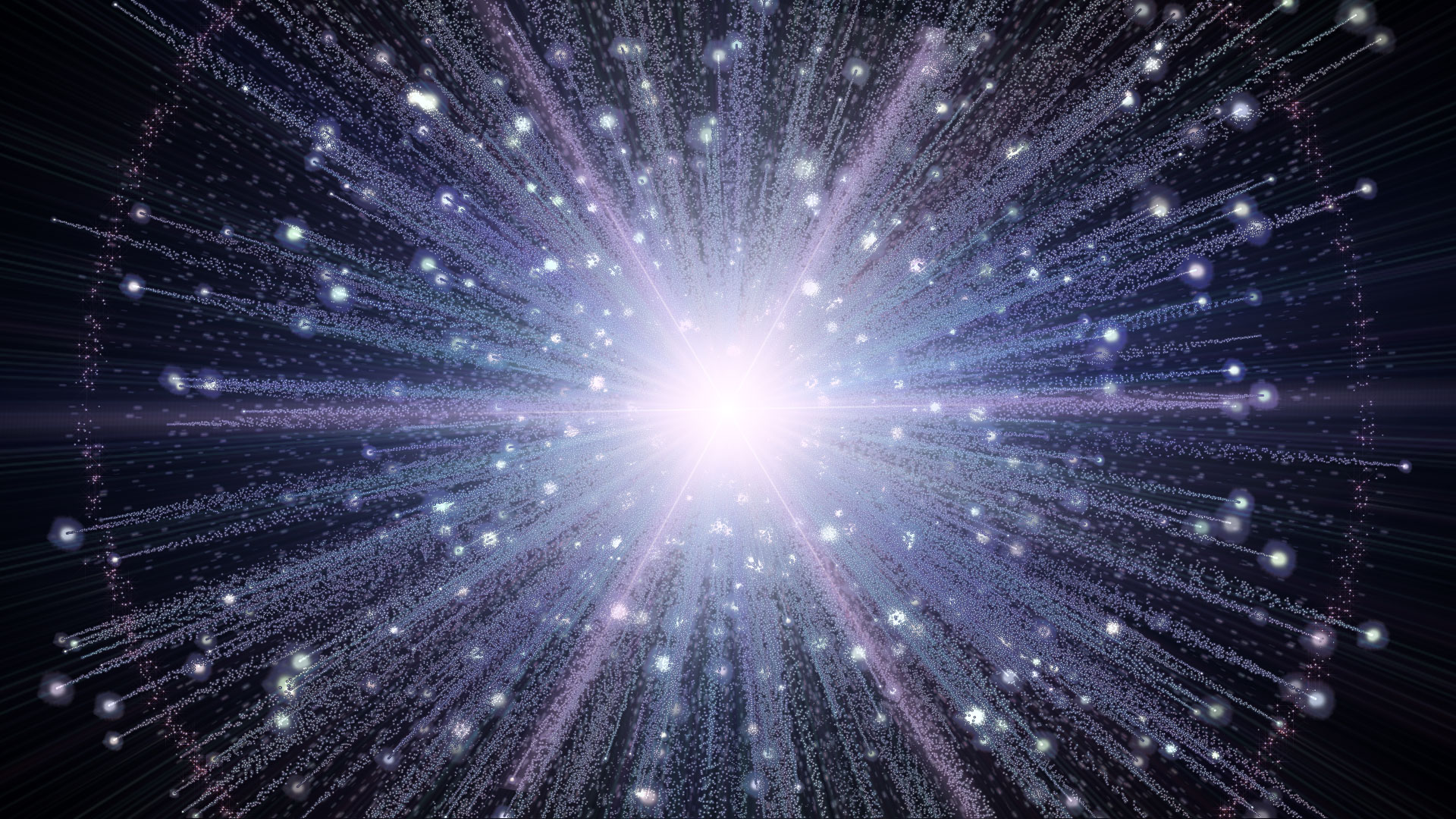
The Big Bang theory is the prevailing cosmological model that describes the early development of the Universe. According to the theory, the Big Bang occurred approximately 13.77 billion years ago, which is thus considered the age of the universe. After this time, the Universe was in an extremely hot and dense state and began expanding rapidly. After the initial expansion, the Universe cooled sufficiently to allow energy to be converted into various subatomic particles, including protons, neutrons, and electrons. Though simple atomic nuclei could have formed quickly, thousands of years were needed before the appearance of the first electrically neutral atoms. The first element produced was hydrogen, along with traces of helium and lithium. Giant clouds of these primordial elements later coalesced through gravity to form stars and galaxies, and the heavier elements were synthesized either within stars or during supernovae.

The Big Bang is a well-tested scientific theory and is widely accepted within the scientific community. It offers a comprehensive explanation for a broad range of observed phenomena, including the abundance of light elements, the cosmic microwave background, large scale structure, and the Hubble diagram for Type Ia supernovae.The core ideas of the Big Bang—the expansion, the early hot state, the formation of helium, and the formation of galaxies—are derived from these and other observations that are independent of any cosmological model. As the distance between galaxy clusters is increasing today, it is inferred that everything was closer together in the past. This idea has been considered in detail back in time to extreme densities and temperatures, and large particle accelerators have been built to experiment in such conditions, resulting in further development of the model. On the other hand, these accelerators have limited capabilities to probe into such high energy regimes. There is little evidence regarding the absolute earliest instant of the expansion. Thus, the Big Bang theory cannot and does not provide any explanation for such an initial condition; rather, it describes and explains the general evolution of the universe going forward from that point on.

Georges LemaĆ®tre first proposed what became the Big Bang theory in what he called his "hypothesis of the primeval atom." Over time, scientists built on his initial ideas to form the modern synthesis. The framework for the Big Bang model relies on Albert Einstein's general relativity and on simplifying assumptions such as homogeneity and isotropy of space. The governing equations had been formulated by Alexander Friedmann. In 1929, Edwin Hubble discovered that the distances to far away galaxies were generally proportional to their redshifts—an idea originally suggested by LemaĆ®tre in 1927. Hubble's observation was taken to indicate that all very distant galaxies and clusters have an apparent velocity directly away from our vantage point: the farther away, the higher the apparent velocity.

             While the scientific community was once divided between supporters of the Big Bang and those of the Steady State theory, most scientists became convinced that some version of the Big Bang scenario best fit observations after the discovery of the cosmic microwave background radiation in 1964, and especially when its spectrum (i.e., the amount of radiation measured at each wavelength) was found to match that of thermal radiation from a black body. Since then, astrophysicists have incorporated a wide range of observational and theoretical additions into the Big Bang model, and its parametrization as the Lambda-CDM model serves as the framework for current investigations of theoretical cosmology.

History of the Universe


Observational history
Throughout recorded history, several cosmologies and cosmogonies have been proposed to account for observations of the Universe. The earliest quantitative geocentric models were developed by the ancient Greek philosophers. Over the centuries, more precise observations and improved theories of gravity led to Copernicus's heliocentric model and the Newtonian model of the Solar System, respectively. Further improvements in astronomy led to the realization that the Solar System is embedded in a galaxy composed of billions of stars, the Milky Way, and that other galaxies exist outside it, as far as astronomical instruments can reach. Careful studies of the distribution of these galaxies and their spectral lines have led to much of modern cosmology. Discovery of the red shift and cosmic microwave background radiation suggested that the Universe is expanding and had a beginning.

History of the universe
According to the prevailing scientific model of the Universe, known as the Big Bang, the Universe expanded from an extremely hot, dense phase called the Planck epoch, in which all the matter and energy of the observable Universe was concentrated. Since the Planck epoch, the Universe has been expanding to its present form, possibly with a brief period (less than 10−32 seconds) of cosmic inflation. Several independent experimental measurements support this theoretical expansion and, more generally, the Big Bang theory. Recent observations indicate that this expansion is accelerating because of dark energy, and that most of the matter in the Universe may be in a form which cannot be detected by present instruments, called dark matter. The common use of the "dark matter" and "dark energy" placeholder names for the unknown entities purported to account for about 95% of the mass-energy density of the Universe demonstrates the present observational and conceptual shortcomings and uncertainties concerning the nature and ultimate fate of the Universe.
Current interpretations of astronomical observations indicate that the age of the Universe is 13.772 ± 0.059 billion years, (whereas the decoupling of light and matter, see CMBR, happened already 380,000 years after the Big Bang), and that the diameter of the observable Universe is at least 93 billion light years or 8.80×1026 meters. According to general relativity, space can expand faster than the speed of light, although we can view only a small portion of the Universe due to the limitation imposed by light speed. Since we cannot observe space beyond the limitations of light (or any electromagnetic radiation), it is uncertain whether the size of the Universe is finite or infinite.

Monday, 4 March 2013

Big Bang and Birth of Planet Earth

What Is the Universe?


The Universe is commonly defined as the totality of existence, including planets, stars, galaxies, the contents of intergalactic space, and all matter and energy. Definitions and usage vary and similar terms include the cosmos, the world and nature.

Scientific observation of the Universe, the observable part of which is about 93 billion light years in diameter, has led to inferences of its earlier stages. These observations suggest that the Universe has been governed by the same physical laws and constants throughout most of its extent and history. The Big Bang theory is the prevailing cosmological model that describes the early development of the Universe, which in physical cosmology is believed to have occurred about 13.77 billion years ago.

There are various multiverse hypotheses, in which physicists have suggested that the Universe might be one among many universes that likewise exist. The farthest distance that it is theoretically possible for humans to see is described as the observable Universe. Observations have shown that the Universe appears to be expanding at an accelerating rate, and a number of models have arisen to predict its ultimate fate.